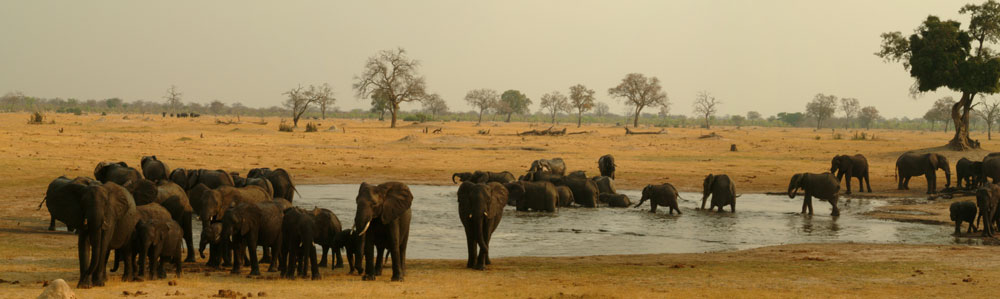
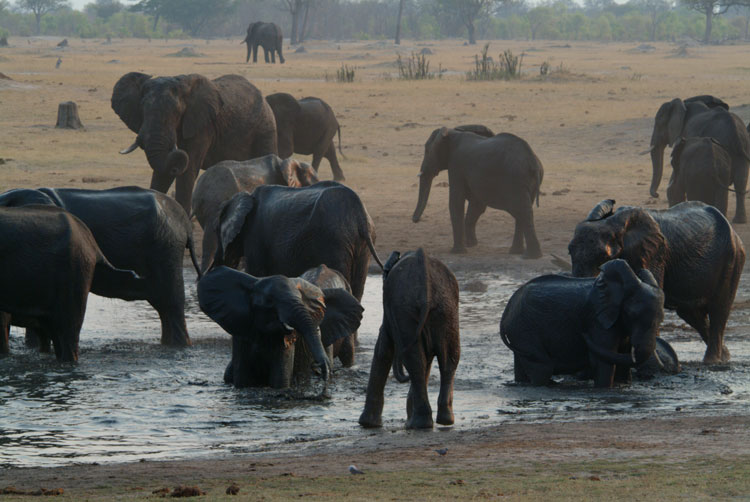
Hwange National ParkHwange, one of the world's last great Elephant sanctuaries, is the largest national park in Zimbabwe
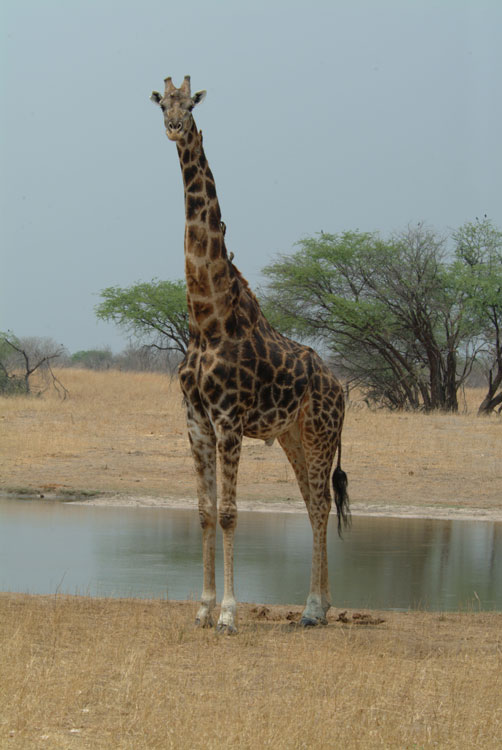
Covering more than 14,600 square kilometers(5,863 square miles) or 1,460,000 hectares it has more animals and a greater variety of species -107- than any other park in the country, and more than 400 species of birds.
It is situated in the south west of Zimbabwe between Bulawayo and Victoria Falls. There are two distinct geographic zones, neither are able to support viable agriculture. The flora of the well drained northern area, part of the Zambezi watershed, is dominated by mopane and mixed terminalia, which is distinctly different from the rest. Elsewhere the Kalahari scrublands, covered with stunted, scattered woodlands of teak and umtshibi trees, drain into Botswana's Makgadikgadi Depression. This habitat is characterised by marshy depressions, vleis and fragile open grasslands on shallow soils. In the nineteen century this land was the royal hunting reserve of Mzilikazi and his successor Lobengula. But the arrival of the first white hunters and settlers signalled the slaughter of its wildlife by the thousands. As their blood soaked deep into the sparse soils, it left empty, useless wasteland, denuded of wildlife, unfit for farming. It was declared a game reserve in 1928 and with neighbouring Robins Game
sanctuary, became a national park under he National Park Act of 1949. Originally,
Robins Game sanctuary belonged to H G Robins, a cattle rancher.  Male Lions Cecil and his brother Jericho photographed near to Ngweshla Camp in Hwange National Park Because his herds were constantly under attack by lion and leopard, Robins turned the ranch into a wildlife preserve. Later in exchange for a new house and a water supply he gave the sanctuary to the government. When founding member Ted Davidson walked across virtually every square kilometre in 1928-29 he discovered the wildlife was almost non existent. The once teeming herds of elephant numbered fewer than 1000 and the rhinoceros, both black and white had been exterminated.
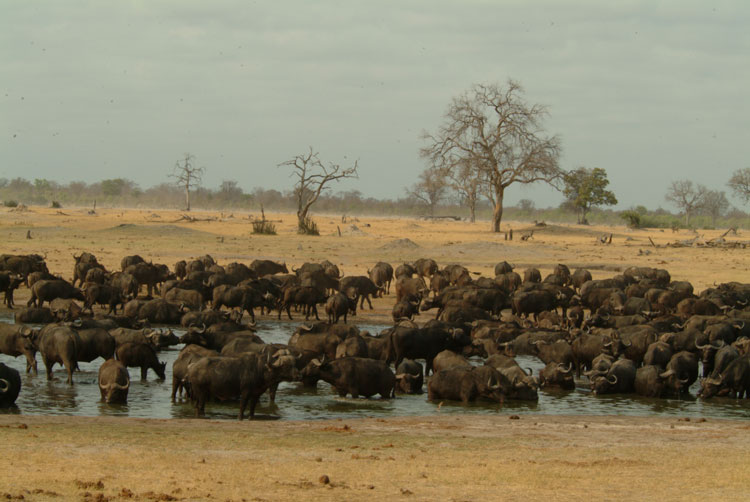
Anyway, the poorly drained Kalahari sands, with their relatively low rainfall, were unable to support permanent large wildlife populations. The seasonal pans and fossil river lines held water all too briefly after the rains, and only occasionally did any large numbers migrate into the region. Davidson perceived that the water was the critical key and in the years that followed he drilled boreholes to create sixty new pans, linked to the seasonal pans that already existed. slowly the animals particularly the elephant and buffalo, began to move back.
Close to half a century later, Hwange National Park faced another, different crisis - too many elephant. Their numbers had risen to more than 20 000 and in their wake the massive beasts left fallen trees and fragile, over grazed grasslands. Hwange's existence was threatened. Wildlife authorities intervened, culling at least 5000 elephant to bring the population down to between 12 000 and 15 000. The maximum that Hwange National Park can support without damage.
In 2010, the numbers had again grown considerably and it is then estimated that the elephant population was somewhere between 30 000 to 40 000 animals. In mid 2017, the numbers had risen to 45 000. This is critical and damage to the environment is certain as the park is only able to sustain 10 000 African elephants. It remains to be seen what the Zimbabwe National Parks does to alleviate this inevitable problem. Water remains the single most important management factor in Hwange's continued existence - absolutely vital to the survival of what is perhaps Africa's single largest concentration of elephant. The constant maintenance of the artificial but natural looking water pans, complete with resident hippo's and crocodile, has been a major factor sustaining this ecological treasury. Without them, Hwange National Park would return to the empty wasteland it once was, animals would die in their thousands. Government funding has long since run out for this maintenance and the onus has now fallen upon a few individual organisations, like "Friends of Hwange" and "Save Hwange" who's efforts are to be highly commended.
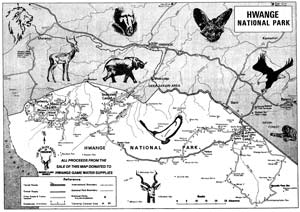
Map of Hwange
This map is available for download by simply clicking on the map.
All we ask is that you Please Help to Raise Funds for Hwange
National Park
by making a donation through the PayPal button below.
All funds go directly to the park.
Thanks to those for your kind donations. See where the money has gone. Hi Tony and Boo,
Add Your Story about Hwange National Park.Have you been there? What did you see? Are you involved in a conservation project there? Have you been on a game count? Anything about this magnificent park... Please Share it! What Other Visitors Have SaidClick on the links below to see contributions from other visitors to this page. You can also comment and rate them...
Exciting Green Season Sightings in Hwange
A Perfect Day In Africa !
Hwange Game Census 2021
Tikobane Trust (Hwange)
It's Green Season in Hwange National Park
Amalinda's Brand New Exclusive Villa
What "Pumping Legs for Water" is About
Friends Of Hwange Update Nov 2016 - Death of Jericho the Lion
Friends of Hwange August 2016 Update
SOMALISA ACACIA
HWANGE NATIONAL PARK - JANUARY 2016
HWANGE NATIONAL PARK ANNUAL GAME COUNT – 2015 Part 1
HWANGE NATIONAL PARK ANNUAL GAME COUNT – 2015 - Part 2
Urgent Apeal for Hwange National park
African Waterfowl Count Hwange National Park July 2015
HWANGE NATIONAL PARK - NEW YEAR 2015
PUMPING LEGS FOR WATER - HWANGE NATIONAL PARK
HWANGE MAIN CAMP
A very exciting game drive
HWANGE NATIONAL PARK – MARCH 2014
Hwange Green Season, February 2014
Hwange National park report November 2013
HWANGE NATIONAL PARK ANNUAL GAME COUNT 2013 part 2
HWANGE NATIONAL PARK ANNUAL GAME COUNT 2013 part 1
HWANGE NATIONAL PARK PUMPING LEGS FOR WATER 2013
Hwange has best park's guides in Southern Africa
Easter in Hwange National park
AFRICAN WATERBIRD COUNT - SINAMATELLA AND ROBINS - HWANGE NATIONAL PARK
Friends of Hwange Newsletter October 2012
HWANGE ANNUAL GAME COUNT – 2012
High School experience
HWANGE – JUNE 2012
HWANGE NATIONAL PARK REPORT MAY, 2012
Friends of Hwange
HWANGE – JANUARY 2012
Hwange Crisis
HWANGE NATIONAL PARK REPORT – OCTOBER 2011 (Part 2)
HWANGE NATIONAL PARK REPORT – OCTOBER 2011 (Part1)
Hwange National Park Update August 2011
Zimbabwe National Parks have a contact with poachers in Hwange
HWANGE: News and Advice
Hwange National Park Report.
Hwange Misses Out on World Cup Tourism

Return from Hwange National Park to our Victoria Falls home page |
Follow!
|
|||||||
|
|
||||||||
|
|
||||||||
|
| ||||||||